
Quanzhou's maritime legacy evolves from ancient Linluan Ferry to modern Shihu Port
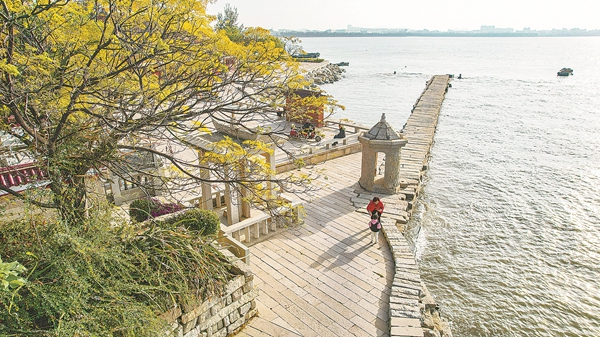
Linluan Ferry is bathed in the glow of the setting sun. [Photo/Fujian Daily]
Linluan Ferry, a ferry built over 1,300 years ago during the Tang Dynasty (618-907), was once a strategic shipping hub in Quanzhou, East China's Fujian province. Known as the medieval "greatest eastern harbor", it linked China's southeast coast to trade networks across Asia, Africa, and Europe along the Maritime Silk Road.
Today, Linluan Ferry remains intact and serves as a small fishing harbor, with the surviving structure 113.5 meters long and 2.2 meters wide. It is now a protected heritage site, designated as part of "Quanzhou: Emporium of the World in Song-Yuan China" — inscribed on the UNESCO World Heritage List in July 2021 as China's 56th World Heritage property.
A key architect of Quanzhou's rise from a fishing village to the "greatest eastern harbor", Lin Luan built the bay's first shipping docks and shipyards, establishing the infrastructure that supported its maritime‑trade legacy. Thus, if the physical Linluan Ferry serves as the tangible World Heritage proof, Lin is the human story that animates it.
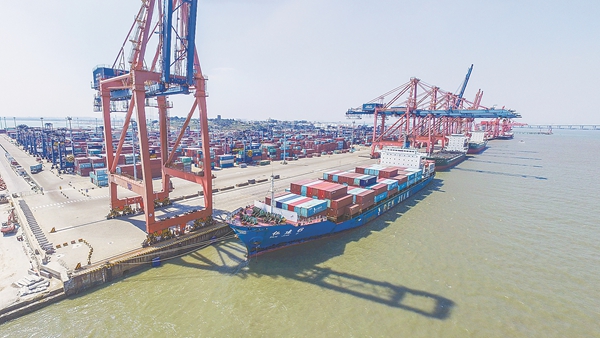
A container ship fully loaded with cargo is berthed at Shihu Port. [Photo/Fujian Daily]
Now Linluan Ferry's legacy is contrasted by the rise of the modern smart Shihu Port just one kilometer away.
As Quanzhou Port's central hub and a national first-class port, Shihu Port maintains dense domestic networks across all key coastal regions in China. Its international routes facilitate access to Belt and Road economies and provide global connectivity via strategic transshipment hubs such as Singapore and Port Klang, Malaysia.