
Fujian's architectural heritage anchors legacy of overseas Chinese
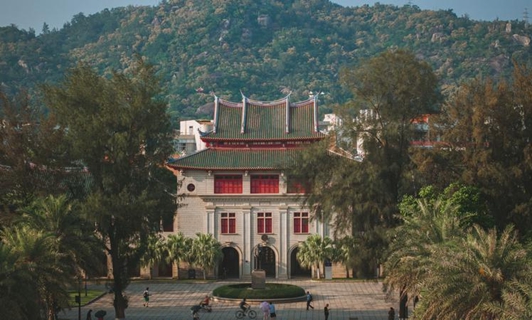
The Qunxian Building Complex is the earliest architectural complex of Xiamen University. [Photo provided to gofujian.com]
Home to some 20 million overseas Chinese, Fujian preserves a rich collection of buildings that serve as both physical landmarks and spiritual anchors for returnees reconnecting with their roots.
At Xiamen University, the Qunxian Building Complex, built by renowned overseas Chinese Tan Kah Kee, features a unique architectural fusion. Its Chinese roofs atop Western structures reflect Tan's vision: embracing global advances while honoring traditional culture. It was listed on China's first 20th-Century Chinese Architectural Heritage List in 2016.
In Jinjiang's Wulin village, the Chaodong Building, funded by Filipino Chinese merchant Cai Xiesha, was way ahead of its time. Completed in 1930, it came with a Byzantine-style dome, Corinthian columns, and the interior spatial pattern of southern Fujian. Yet its interior was never finished, a deliberate choice. At the height of the Chinese People's War of Resistance Against Japanese Aggression (1931-45), Cai donated all renovation funds to support the war effort, leaving behind a powerful symbol of patriotism.
Further south in Zhangzhou's Liuchuan village stands the Tianyi Post Office, China's first private international postal service. Founded in 1880 by returned emigrant Guo Youpin, it handled "Qiaopi" — special mail containing both letters and remittances — that connected overseas Chinese with their families. At its peak, Tianyi had 26 branches across Southeast Asia, including in what are now the Philippines, Indonesia, Malaysia, and Thailand.
In recent years, Fujian has stepped up efforts to protect and revitalize these architectural treasures, ensuring that the legacy and spirit of overseas Chinese continue to inspire generations to come.


